
Pick Your Mortgage Player Between FHA VA and Conventional
The Real Difference Between FHA, VA, and Conventional Loans (And Which One Wins for You)
Choosing between FHA, VA, and conventional loans is one of the most important decisions you'll make as a homebuyer — and the wrong choice can cost you thousands of dollars over the life of your loan.
Here's a fast answer if you need it now:
Loan Type | Best For | Min. Down Payment | Min. Credit Score | Mortgage Insurance |
|---|---|---|---|---|
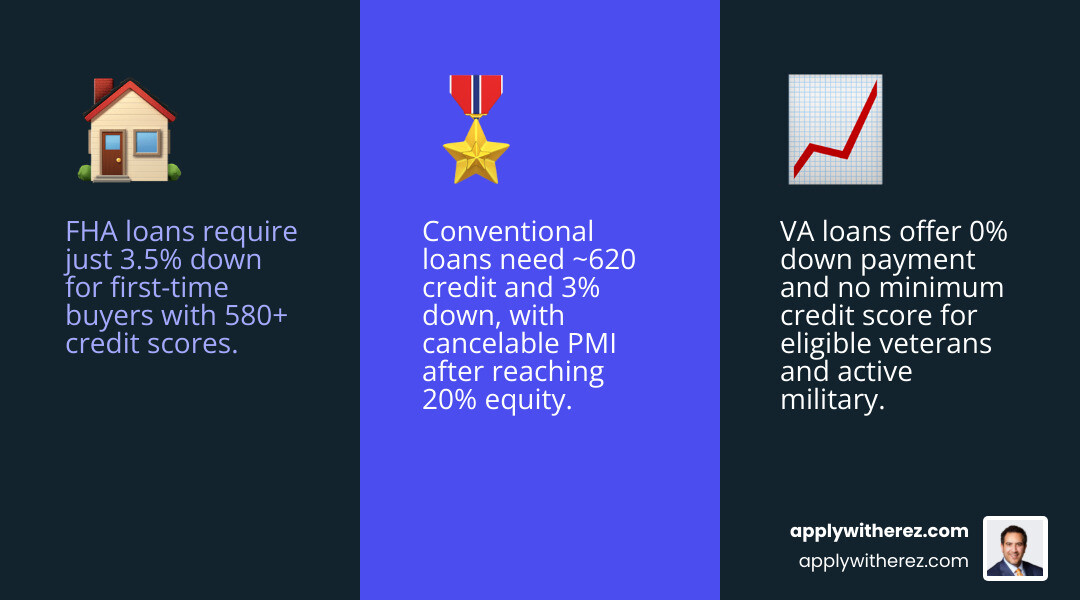
FHA | First-time buyers, lower credit | 3.5% | 580 (or 500 with 10% down) | Required (upfront + annual) |
VA | Veterans, active military, eligible spouses | 0% | None set by VA | None required |
Conventional | Strong credit, 20%+ down, competitive offers | 3% | ~620 | Only if < 20% down (cancelable) |
The short version:
VA loans are the best deal available — if you qualify
FHA loans open the door when credit or savings are limited
Conventional loans win when you have strong credit and want fewer restrictions
No single loan type is the best for everyone. Your credit score, military status, savings, and the home you're buying all push the answer in different directions. More than 83% of FHA borrowers in 2020 were first-time buyers — that tells you something about who each loan is really built for.
I'm Erez Shimoni, a mortgage broker with 26 years of experience helping borrowers navigate FHA, VA, and conventional loan options across New Jersey, New York, Pennsylvania, and Florida. In this guide, I'll walk you through exactly how each loan works — so you can make a confident, informed choice.
Introduction to FHA VA Conventional Loan Choices
When people search for fha va conventional, what they usually want is simple: "Which mortgage gives me the best chance to buy a home without overpaying?"
That is the right question.
All three loan types can help you buy a home, but they are built for different borrower profiles:
FHA is designed to help buyers with lower credit scores or smaller down payments
VA is a benefit for eligible military borrowers and surviving spouses
Conventional works best when your credit, income, and cash reserves are stronger
In 2026, this choice matters even more because affordability is tight. A small difference in down payment, mortgage insurance, or rate can change your monthly payment a lot more than most buyers expect.

FHA VA Conventional: Core Differences That Shape Your Approval
The biggest divide is this:
FHA and VA are government-backed loans
Conventional loans are not government-backed
That does not mean the government lends you the money directly. Private lenders still make the loan. The difference is the backing:
FHA loans are insured by the Federal Housing Administration
VA loans are guaranteed by the Department of Veterans Affairs
Conventional loans follow standards set by Fannie Mae and Freddie Mac if they are conforming, but they do not have government insurance or guarantees like FHA and VA
That backing changes how each program handles:
credit score flexibility
down payment requirements
debt-to-income tolerance
mortgage insurance
property standards
seller perception in competitive markets

What Is an FHA Loan and Who Is It Best For?
An FHA loan is a government-backed mortgage designed to help buyers who may not qualify for stricter financing. It is especially popular with first-time buyers, and the numbers support that: more than 83% of FHA borrowers in 2020 were first-time buyers.
FHA is usually best for:
first-time buyers
borrowers with lower credit scores
buyers with limited savings
borrowers who need more flexible underwriting
Key FHA basics:
minimum 3.5% down with a 580+ credit score
possible with a 500 score if you put 10% down
intended for owner-occupied homes
requires mortgage insurance
If your file is a little bumpy, think lower credit, higher DTI, or less cash, FHA often gives you a path forward when conventional says "come back later."
What Is a VA Loan and Who Can Qualify?
A VA loan is one of the strongest mortgage benefits available. It is for eligible:
veterans
active-duty service members
some Reserve and National Guard members
certain eligible surviving spouses
You usually need a Certificate of Eligibility to confirm that you qualify. The VA itself does not set a universal minimum credit score, though individual lenders often do apply their own standards.
Why borrowers love VA loans:
0% down payment is available
no monthly mortgage insurance is required
underwriting is often flexible compared with conventional
rates are often very competitive
For many eligible buyers, VA is the best overall deal. If you want a deeper look, visit our VA Home Loan page or read Fourteen Advantages of a VA Home Loan.
What Is a Conventional Loan and How Is It Different?
A conventional loan is any mortgage that is not backed by FHA, VA, or another government program. Many conventional loans are conforming, which means they meet Fannie Mae or Freddie Mac guidelines. Others are nonconforming, such as jumbo loans.
Conventional is often best for:
buyers with stronger credit
borrowers with lower DTI
buyers with solid savings
borrowers who want fewer property restrictions
second-home or investment-property buyers
Key differences from FHA and VA:
no government insurance or guarantee
usually stricter approval standards
can be used more flexibly for certain property types
PMI is only required if down payment is under 20%
PMI can usually be removed later
In plain English: conventional rewards financial strength.
FHA VA Conventional Requirements: Credit Score, Down Payment, and DTI
Approval usually comes down to three big numbers:
credit score
down payment
debt-to-income ratio
Here is the quick comparison:
Feature | FHA | VA | Conventional |
|---|---|---|---|
Typical minimum credit score | 580 for 3.5% down, 500 with 10% down | No VA-set minimum, lender standards apply | Around 620 |
Minimum down payment | 3.5% | 0% | 3% in some cases |
Typical DTI guideline | 43% to 45%, sometimes higher | 41% guideline, can go higher with strengths | 43%, sometimes up to 50% |
Mortgage insurance | Required | None required | Required only under 20% down |
Minimum Credit Scores for FHA VA Conventional Loans
Credit score rules are one place where these loans really separate.
FHA:
580 is the common threshold for 3.5% down
500 to 579 may still work with 10% down
VA:
the VA does not set a hard minimum score
lenders still use overlays, so approval is not automatic
VA can be more forgiving than conventional for borrowers with uneven credit
Conventional:
around 620 is the common minimum
some automated approvals may expect more depending on the file
A quick reality check: the posted minimum score is not the same as the score needed for a good deal. A 620 borrower and a 760 borrower can both get approved conventionally, but they will not get treated the same on pricing.
Down Payment Rules and Cash Needed at Closing
This is where buyers often perk up.
FHA:
3.5% down with 580+
10% down with scores from 500 to 579
VA:
0% down for eligible borrowers
Conventional:
as low as 3% down for some programs
5% is common
20% down avoids PMI
Down payment is not the whole cash story. You may also need:
closing costs
prepaid taxes and insurance
appraisal fee
inspection costs
reserves in some cases
Gift funds may be allowed depending on the loan type and scenario. Seller concessions may also help offset closing costs, but limits vary.
If you want to estimate your payment before you fall in love with a house and start naming the guest room, use our Calculator.
Debt-to-Income Limits and What Lenders Really Look For
DTI measures how much of your gross monthly income goes toward debt payments.
General guidelines:
FHA often targets 43% to 45%, with some approvals going higher
VA uses a 41% guideline, but approvals can exceed that with strong compensating factors
Conventional commonly aims for 43%, though some files can stretch toward 50%
What helps if DTI is high?
strong credit
extra savings or reserves
larger down payment
stable income
low payment shock
for VA, strong residual income
This is why two borrowers with the same DTI can get different answers. Lenders are not just checking one box. They are looking at the whole file.
Costs, Loan Limits, and Mortgage Insurance Compared
The monthly payment is only part of the math. The long-term winner depends on:
upfront fees
mortgage insurance
rate
closing costs
how long you plan to keep the loan
FHA vs VA vs Conventional Loan Limits in 2026
For 2026, the research shows:
FHA loan limit for a one-unit property is $541,287 in most markets
FHA can go up to $1,249,125 in higher-cost areas
Conventional conforming starts at $832,750 in most areas
Conventional can also go up to $1,249,125 in high-cost markets
VA is different. Modern VA loans do not work off the same simple published loan cap structure for borrowers with full entitlement the way FHA and conforming conventional do. In practice, entitlement and lender guidelines matter more than a standard single national base limit.
That means:
FHA usually has lower loan limits than conventional
conventional may allow more borrowing before you need jumbo financing
VA can be very powerful for eligible borrowers depending on entitlement and lender approval
Mortgage Insurance, Funding Fees, and When They Go Away
This section is where the lifetime cost battle gets interesting.
FHA:
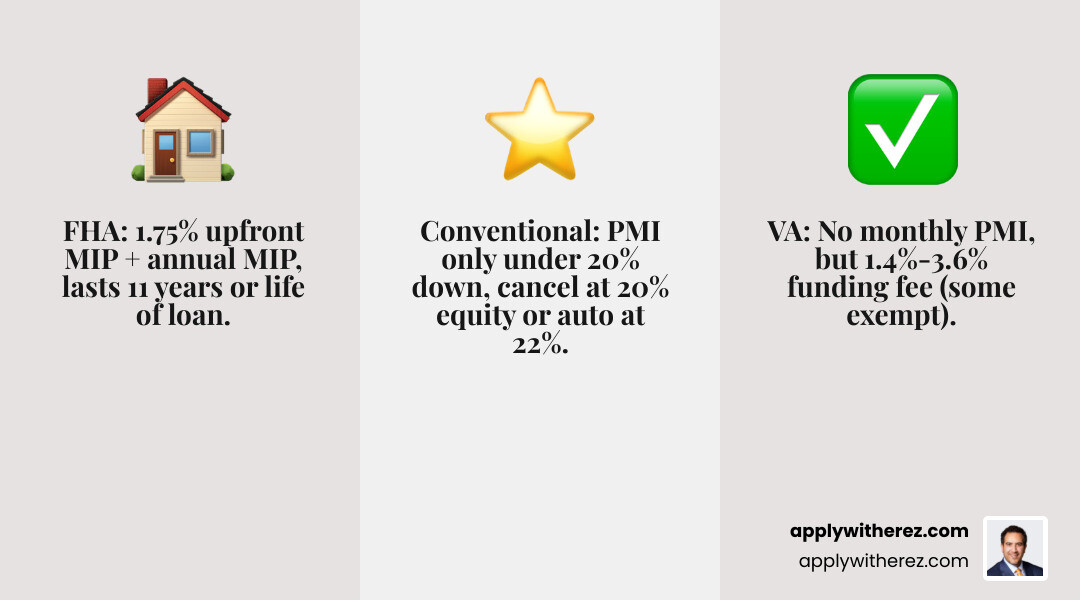
requires an upfront mortgage insurance premium of 1.75% of the loan amount
also charges annual mortgage insurance
depending on the down payment and loan terms, FHA mortgage insurance can last for 11 years or for the life of the loan
VA:
no monthly mortgage insurance
most borrowers pay a VA funding fee
the funding fee varies, often in a range roughly from 1.4% to 3.6% depending on use and down payment
some borrowers are exempt from the funding fee
Conventional:
requires PMI only if you put less than 20% down
PMI can generally be canceled when you reach 20% equity
it is automatically removed at 22% equity under standard rules
This is a huge reason borrowers refinance out of FHA later. FHA can be easier to get into, but conventional can become cheaper once your credit and equity improve.
Interest Rates and Closing Costs: What Usually Costs Less Over Time?
Rates move daily, so no article can promise your exact pricing. But the research gives us a useful snapshot: in February 2026, the national average 30-year FHA rate was 6.16%, while conventional was 6.09%.
That difference is small, but rate alone does not decide the cheapest loan.
You also have to compare:
FHA upfront and annual MIP
VA funding fee versus no monthly mortgage insurance
conventional PMI, if any
lender fees
title and escrow charges
discount points
seller credits
how long you plan to keep the loan
Examples:
FHA may approve you more easily, but MIP can make it cost more over time
VA may beat both because it has no monthly mortgage insurance
conventional may start strong for high-credit borrowers and get even better once PMI is gone
If you already have an FHA or VA loan, a future Refinance into conventional may make sense when the math works.
Choosing the Best Loan for Your Situation and Market
The best mortgage is not the one with the flashiest ad. It is the one that fits your profile, your home, and your market.
Which Loan Fits First-Time Buyers, Military Borrowers, and High-Credit Buyers Best?
For first-time buyers with lower credit scores:
FHA is often the best fit
lower down payment
easier qualification
popular with first-time buyers for a reason
For military members, veterans, and eligible spouses:
VA is usually the first place to look
0% down and no monthly mortgage insurance is tough to beat
For buyers with good credit and savings:
conventional often wins
especially strong if you can put 20% down and avoid PMI
even with less than 20% down, conventional may still beat FHA if your credit is strong
A simple rule:
lower credit and less cash: FHA
military eligibility: VA
strong credit and stronger savings: conventional
If you are getting ready to shop, our Buy a Home page can help you plan the next step.
Property Requirements, Appraisals, and Seller Preference in Competitive Markets
This is where loan type affects more than your budget.
FHA and VA appraisals include property condition standards. The home generally needs to meet minimum safety, security, and soundness standards. That can create issues if the property has:
peeling paint
broken utilities
major repair concerns
health or safety problems
Conventional appraisals are often seen as more flexible on condition, which is one reason sellers may prefer conventional offers.
Why sellers often like conventional:
fewer repair-related surprises
fewer government program perceptions
smoother path on certain properties
sometimes faster or simpler closing
That does not mean FHA or VA is bad. It means the house needs to fit the loan.
For investment properties:
FHA and VA are primarily for owner-occupied homes
conventional is usually the more flexible option for investment properties and many second homes
FHA and VA can sometimes be used for 1-4 unit properties if the borrower occupies one unit, but occupancy rules matter a lot.
When to Refinance From FHA or VA to Conventional
Yes, you can refinance from FHA to conventional, and you can often refinance from VA to conventional too.
Common reasons to do it:
remove FHA mortgage insurance
eliminate PMI sooner based on new equity position
lower your rate
change loan term
move from a government-backed loan to a more flexible structure
cash out equity, depending on the situation
When refinancing from FHA to conventional often makes sense:
your credit score improved
your home value increased
you now have at least 20% equity or close to it
the new payment and closing-cost break-even works in your favor
For VA borrowers, refinancing to conventional is less common if the VA loan is already excellent, but it can still make sense in certain rate, equity, or strategy situations.
Pros and Cons of Each Mortgage Player
No loan is perfect. Every option is a tradeoff between easier approval and lower long-term cost.
FHA VA Conventional Pros and Cons Side by Side
FHA pros:
easier credit qualification
low 3.5% down payment
helpful for first-time buyers
flexible DTI in many cases
FHA cons:
upfront MIP of 1.75%
annual mortgage insurance required
MIP may last a long time or for the life of the loan
stricter property standards than many conventional loans
VA pros:
0% down
no monthly mortgage insurance
often competitive rates
flexible underwriting for eligible borrowers
VA cons:
only for eligible borrowers
funding fee may apply
property standards and appraisal requirements can affect some deals
Conventional pros:
no upfront government insurance fee
PMI only if under 20% down
PMI is cancelable
strong seller appeal in many markets
better flexibility for second homes and investment properties
Conventional cons:
stricter credit standards
stricter income and DTI standards in many cases
may cost more than FHA for lower-credit borrowers
usually less forgiving overall
If you want a neutral reference on how these programs are defined, the Consumer Financial Protection Bureau offers helpful homebuying and mortgage education.
Extra Fees and Common Mistakes Borrowers Overlook
Buyers focus on rate and forget the hidden players:
FHA upfront MIP
VA funding fee
conventional PMI
prepaid taxes and insurance
escrow setup
appraisal and inspection costs
reserves, if required
And then there are the classic self-inflicted wounds:
opening new credit before closing
buying a car mid-transaction
changing jobs without checking impact
missing bill payments
moving money around without documentation
If you want to avoid those headaches, read Five Simple Steps to Get Your Finances in Order and 9 Mistakes That Can Affect Your Mortgage.
For general education, you can also review resources from official housing agencies and major consumer finance publishers.
Frequently Asked Questions About FHA VA Conventional
Is FHA, VA, or conventional better in 2026?
Better depends on your profile.
VA is usually best if you are eligible
FHA is often best if your credit is lower or your down payment is limited
conventional is often best if you have strong credit, stable income, and decent savings
In 2026, the smart move is to compare total monthly payment and total cost, not just the rate.
Can you use FHA, VA, or conventional for investment properties?
Usually:
FHA is mainly for owner-occupied homes
VA is also primarily for primary residences
conventional is the most flexible for investment properties
FHA or VA may work on 1-4 unit homes if you live in one unit, but they are not standard investor loans.
Why do sellers often prefer conventional offers?
Sellers often view conventional as cleaner because:
appraisal standards may be less strict
fewer repair issues may come up
there is often more confidence in closing
strong-credit buyers frequently use conventional financing
In a competitive market, that can matter. But a strong FHA or VA buyer with good documentation and a smart strategy can still win.
Conclusion: How to Pick the Right Mortgage With Confidence
If you feel torn between FHA, VA, and conventional, that is normal. This is not a personality test where the answer is "which loan are you?" It is a math-and-strategy decision.
Here is the process we recommend:
Check whether you are eligible for VA first
Review your credit score and current DTI
Figure out how much cash you can comfortably bring to closing
Compare total monthly payment, not just the interest rate
Think about the property type and how competitive your market is
Ask whether mortgage insurance can be removed later
Compare refinance options before you commit
If you are eligible for VA, start there. If your credit or savings are limited, FHA may be your bridge into homeownership. If your credit is strong and you want fewer restrictions, conventional may be the better long-term play.
If you want help sorting through the numbers, we are here to walk you through it. Start by exploring our VA Home Loan page and compare your options with a real strategy behind them.