The Ultimate Guide to the Mortgage Loan Officer Career Path
A Clear Look at Being a Mortgage Loan Officer
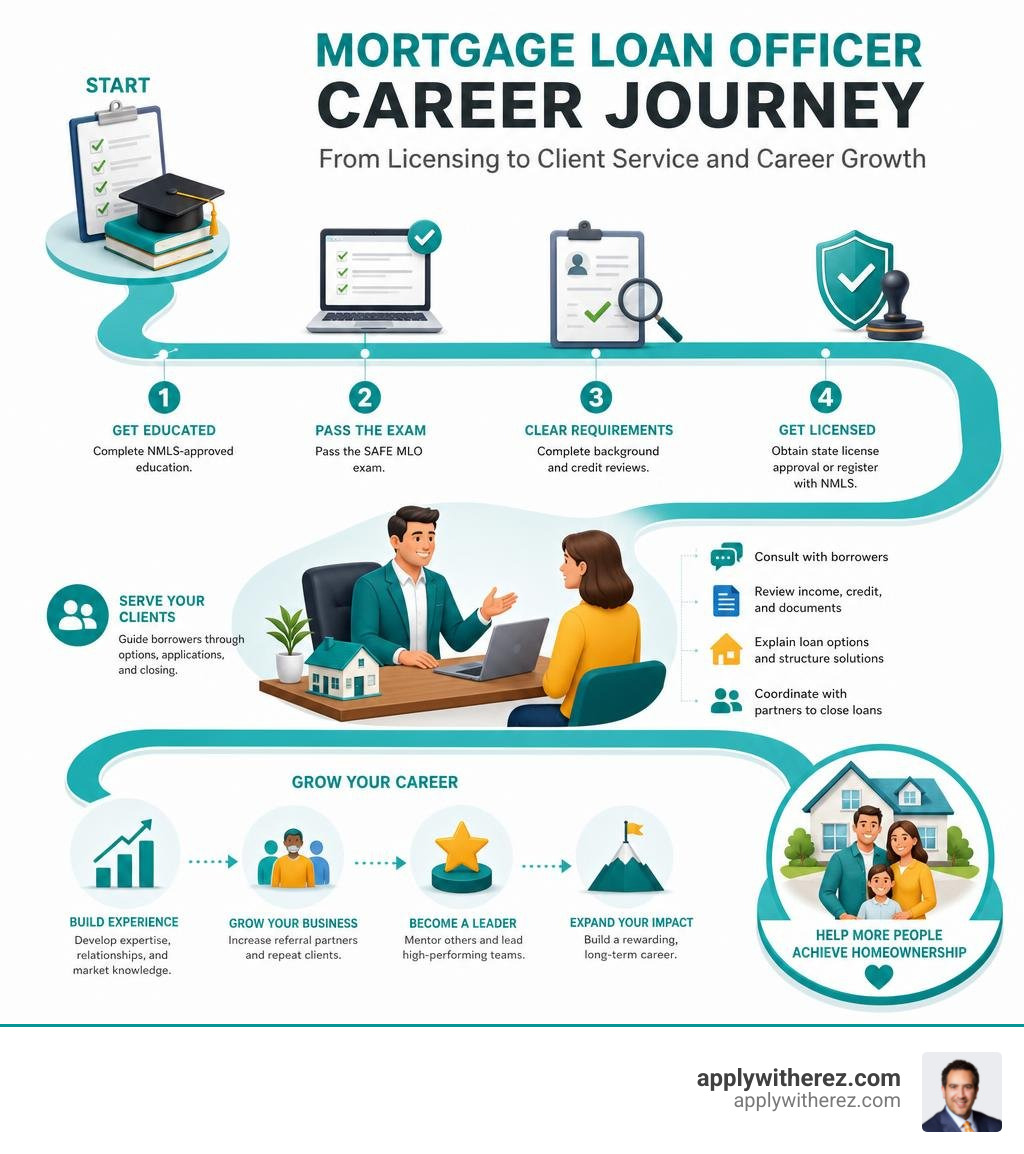
Being a mortgage loan officer means helping people choose, apply for, and close home loans. The work blends sales, financial analysis, customer service, and strict compliance. On a typical day, an MLO speaks with borrowers, reviews income and credit documents, explains loan options, coordinates with processors and underwriters, and builds relationships with real estate agents and other referral partners.
It can be a rewarding career for someone who likes solving financial problems and guiding people through major decisions. But it is also performance-driven: income can vary with loan volume, housing activity, and interest rates. The U.S. Bureau of Labor Statistics reports a median annual wage of $74,180 for loan officers in May 2024, while projected employment growth is 2% from 2024 to 2034.
For most people working at non-bank mortgage companies or brokerages, the path starts with NMLS-approved education, passing the SAFE MLO exam, clearing background and credit reviews, and obtaining state license approval. Bank and credit union originators generally register with NMLS rather than hold a state MLO license.
I am Erez Shimoni, an NMLS-licensed mortgage professional with 26 years of experience guiding borrowers from loan origination through closing across New Jersey, New York, Pennsylvania, and Florida. In this guide, I will share what being a mortgage loan officer involves, how licensing works, and what it takes to build a durable career in the field.
What Is Being a Mortgage Loan Officer Really Like?
When we examine the day-to-day rhythm of the mortgage industry, loan officers operate at the intersection of consumer finance, real estate sales, and federal compliance. The role is rarely confined to a traditional desk job. Instead, it involves active problem-solving, continuous client intake, and hands-on deal management.
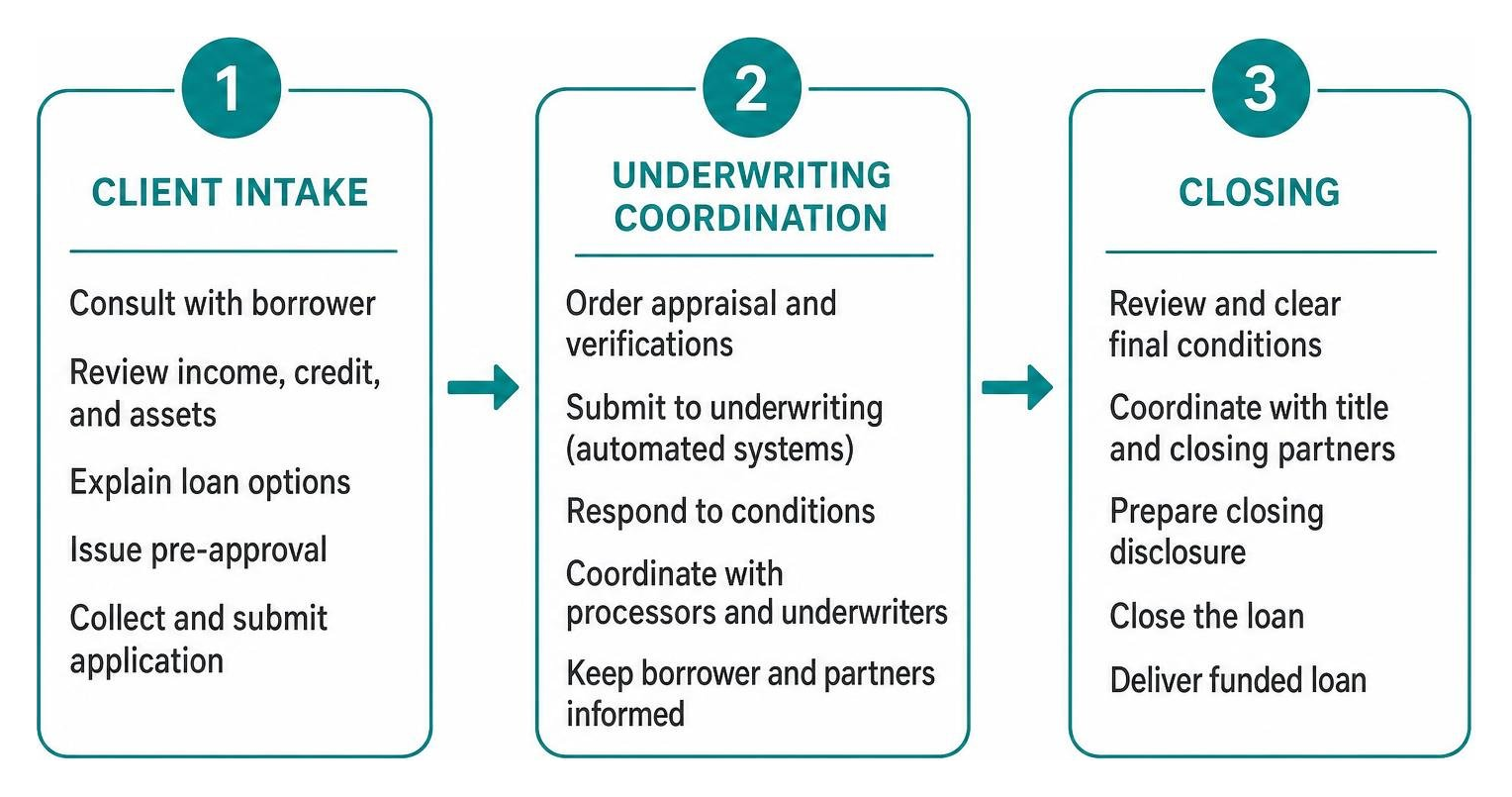
An originator begins each file by gathering comprehensive borrower data. This includes reviewing pay stubs, tax returns, W-2s, asset statements, and credit reports to evaluate purchasing power. From there, the loan officer structures viable financing options, issues pre-approval letters, and submits files into automated underwriting systems. Once a purchase contract or refinance application is locked in, the loan officer coordinates between the borrower, real estate agents, loan processors, appraisers, title companies, and underwriter teams to carry the loan across the finish line.
Core Roles and How MLOs Compare to Brokers and Processors
The mortgage sector contains several specialized titles that sound similar but carry distinct responsibilities, licensing requirements, and legal obligations. Understanding these differences is essential when mapping out your career path.
Mortgage Loan Originator (MLO): A licensed professional who works with borrowers to select mortgage products, take applications, negotiate interest rates, and structure loans. MLOs at non-bank institutions must be licensed through the Nationwide Multistate Licensing System (NMLS), while originators at federally insured banks or credit unions are registered.
Mortgage Broker: An independent business owner or entity that maintains lending relationships with multiple wholesale mortgage lenders. Brokers supervise loan officers and connect borrowers with competitive loan programs across multiple investor platforms. Becoming a broker typically requires years of origination experience, advanced licensing, and corporate net worth benchmarks.
Loan Processor: An operations professional who organizes documentation, verifies employment and bank deposits, orders title work and property appraisals, and ensures files meet strict underwriter checklists. Processors generally work under direct supervision and handle the administrative operational lifecycle of a file.
Feature / Role | Mortgage Loan Officer (MLO) | Mortgage Broker | Loan Processor |
|---|---|---|---|
Primary Focus | Client intake, sales, loan structuring | Business management, lender relations | Document gathering, verification |
Client Facing? | Yes | Yes | Yes (administrative support) |
Licensing Needed | State MLO License (NMLS) | Mortgage Broker Business License | Generally unlicensed (supervised) |
Compensation | Commission, base salary, or hybrid | Company profit & origination revenue | Hourly wage or base salary + per-file bonus |
Supervision | Works under a broker or lender | Supervises company operations & MLOs | Works under an MLO or operations manager |
Key Loan Programs from Conventional to Specialized Mortgages
A top-tier loan officer must master diverse mortgage programs to serve different borrower demographics across New York, New Jersey, and Pennsylvania:
Conventional Conforming Loans: Financing structured to meet Fannie Mae and Freddie Mac guidelines, serving borrowers with solid credit scores and standard documentation.
Government Financing (FHA & VA): Helping first-time buyers with flexible credit parameters, or assisting active-duty military and veterans looking to secure a VA home loan with zero down payment.
Purchase Transactions: Providing clear financial clarity to buyers seeking to buy a home in competitive housing markets.
Refinance Options: Structuring a refinance to lower monthly obligations, eliminate private mortgage insurance, or extract cash equity.
Senior Solutions: Educating homeowners aged 62 and older on the benefits and mechanics of a reverse mortgage to access home equity without monthly principal and interest payments.
Step-by-Step Roadmap to Earning Your Mortgage License

Getting into the mortgage profession requires navigating a structured, legally mandated licensing process designed to protect consumers and uphold lending integrity across the nation.
NMLS Account, SAFE Act Rules, and Pre-Licensing Education
The foundation of modern mortgage licensing stems from the Secure and Fair Enforcement for Mortgage Licensing Act of 2008 (the SAFE Act). The SAFE Act established minimum national licensing standards, pre-licensing education guidelines, and centralized oversight managed through the Nationwide Multistate Licensing System (NMLS).
To begin, you must establish an account on the NMLS website to receive your permanent NMLS Unique Identifier. This number tracks your licensing, education records, and regulatory filings throughout your lending career.
Next, you must complete the mandatory 20 hours of NMLS-approved Pre-Licensing Education (PE). According to occupational classifications detailed in the 13-2072.00 - Loan Officers profile, understanding federal regulations and ethics is foundational to the trade. The baseline 20-hour curriculum covers:
3 hours of federal mortgage laws and regulations (e.g., TRID, RESPA, TILA, ECOA)
3 hours of ethics, consumer protection, and fraud prevention
2 hours of nontraditional mortgage product standards
12 hours of general electives and loan origination fundamentals
Depending on where you plan to conduct business, individual state agencies may mandate supplemental state-specific coursework. For instance, New York requires 3 hours of state-specific education (23 hours total), New Jersey mandates 4 state-specific hours (24 hours total), and Pennsylvania requires 3 state-specific hours (23 hours total).
Passing the National SAFE Exam and Background Checks
Once your pre-licensing coursework is logged in the NMLS database, you can schedule your National SAFE MLO Test with Uniform State Test (UST) component.
The exam is rigorous:
Format: 120 multiple-choice questions (115 scored, 5 unscored experimental items)
Time Allotted: 190 minutes
Passing Benchmark: 75% or higher
National Pass Rate: The first-time pass rate sits at approximately 55%.
Because the test is challenging, dedicating time to practice exams and comprehensive study guides is critical. If an applicant fails, NMLS rules impose a mandatory 30-day waiting period between the first three attempts. If an applicant does not pass on the third try, a 180-day waiting period is enforced before testing can resume.
Alongside the exam, you must submit authorization for an FBI criminal background check (via electronic fingerprinting) and an independent credit check. State regulators review these reports to verify financial responsibility and character. Prior felony convictions involving fraud, dishonesty, or breach of trust result in statutory disqualification.
Multistate Licensing and Sponsor Activation
Passing the exam makes you license-eligible, but your license remains inactive until you associate your NMLS record with an approved employer. Once an established mortgage brokerage or lending institution files a formal sponsorship request through the NMLS portal, your state license becomes active, allowing you to originate loans legally.
Because neighboring real estate markets often overlap—especially in the tri-state area of New York, New Jersey, and Pennsylvania—many originators hold licenses in multiple states. Expanding your footprint involves completing each state's elective coursework, submitting the respective state application fees, and satisfying local regulator requirements.
To maintain your license year after year, originators must complete a minimum of 8 hours of NMLS-approved Continuing Education (CE) annually and submit formal license renewals during the statutory NMLS renewal window between November 1 and December 31.
Skills, Compensation, and Career Growth

A sustainable career in mortgage lending depends on technical aptitude, sales discipline, and resilient relationship building.
Essential Skills for Being a Mortgage Loan Officer
Top originators combine analytical precision with exceptional interpersonal communication:
Pipeline & Relationship Management: Roughly 60% to 80% of an originator's production comes from professional referral sources, such as real estate agents, CPAs, financial planners, and past clients.
Technical Literacy: Originators must master automated underwriting engines like Fannie Mae's Desktop Underwriter (DU) and Freddie Mac's Loan Product Advisor (LPA), along with modern Loan Origination Systems (LOS) like Encompass.
Active Listening & Consultative Problem-Solving: Listening closely to borrower goals enables originators to structure debt-to-income profiles that comply with stringent investor guidelines.
Continuous Industry Learning: Staying informed about changing mortgage guidelines, interest rate trends, and secondary market shifts by reading industry insights on our blog.
The Financial Reality of Being a Mortgage Loan Officer: Compensation and Outlook
Mortgage compensation is largely performance-driven. While some depository banks offer base salaries, independent mortgage brokerages and non-bank lenders typically compensate originators via commission or basis points (bps) per closed loan volume (100 basis points equals 1.00% of the loan amount).
According to the Loan Officers : Occupational Outlook Handbook: : U.S. Bureau of Labor Statistics , the median annual wage for loan officers was $74,180 in May 2024. Compensation spreads show wide variance:
Bottom 10%: Earned less than $38,490
Top 10%: Earned more than $145,780, with high-producing retail originators generating substantially higher income based on volume.
Federal labor data projects loan officer employment to grow 2% from 2024 to 2034. While automated underwriting software and bank branch consolidations have moderated aggregate headcount growth, approximately 20,300 annual job openings are projected over the decade due to retirements, career transitions, and the irreplaceable need for human guidance during complex purchase transactions.
Frequently Asked Questions About Becoming an MLO
Do I need a college degree or perfect credit to become an MLO?
No, a college degree is not legally required to obtain an MLO license. A high school diploma or equivalent satisfies educational entry prerequisites, although coursework in finance, accounting, or business can provide helpful analytical foundations.
Regarding credit, you do not need a perfect credit score. State licensing regulators do not evaluate your credit score number; instead, they review your overall credit report to gauge fiscal responsibility. Outstanding tax liens, patterns of unpaid bills, or recent foreclosures may prompt regulatory scrutiny, but reasonable credit challenges can often be addressed through written letters of explanation.
How long does it take and how much does it cost to get licensed?
On average, it takes about 6 weeks from start to finish to become fully licensed and sponsored. Pre-licensing coursework can be completed online in as little as 4 to 14 days, while exam scheduling, background check processing, and state agency application reviews account for the remaining time.
Total out-of-pocket startup costs generally range between $400 and $600:
NMLS Pre-Licensing Education Course: $150 – $300
National SAFE MLO Test Fee: $110
Criminal Background Check & Fingerprinting: ~$36
NMLS Credit Report Fee: $15
Individual State License Application Fees: $100 – $300+ (depending on the state)
Can I work independently as a mortgage loan officer?
An individual holding an MLO license cannot operate as an independent freelance lender. By law, licensed mortgage loan originators must be formally sponsored and supervised by a licensed mortgage brokerage or approved lending institution. To operate independently and employ other originators, an individual must obtain a separate Mortgage Broker or Mortgage Banker license, which typically requires multiple years of verified industry experience and specific corporate capital reserves.
Conclusion
A career as a mortgage loan officer offers an engaging combination of financial problem-solving, entrepreneurship, and community impact. By helping homebuyers navigate one of the largest transactions of their lives, you build valuable professional relationships and establish a meaningful career foundation.
Whether you are exploring mortgage career paths or seeking experienced lending advice in New York, New Jersey, or Pennsylvania, visit applywitherez.com to learn how our dedicated team delivers clear, personalized financing solutions.